
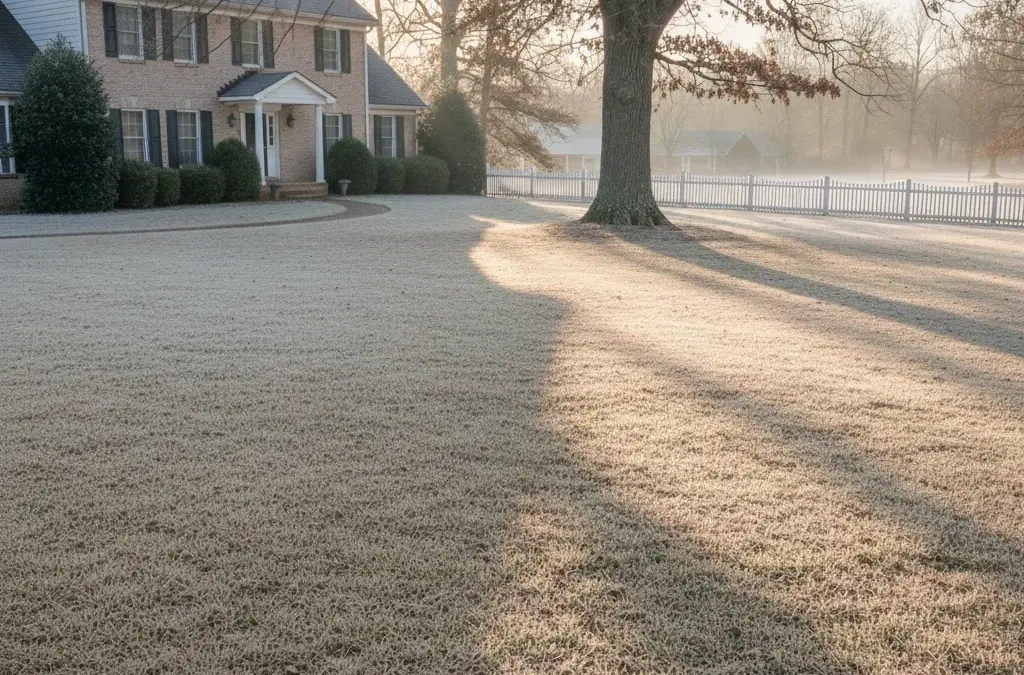
Your Lawn Is Sleeping, Not Dead: What January Really Looks Like in Cumberland County
Week of January 5
If you’re standing in your yard this January wondering “What happened to my lawn?”—you’re not alone. Across Cumberland County, from Haymount to Hope Mills, Vander to the edges of Fort Bragg, lawns look brown, thin, and quiet. That’s not failure. That’s dormancy.
In the Sandhills, winter lawns don’t “die.” They rest.
Understanding what normal looks like this time of year—and what not to panic over—can save you money, prevent damage, and set your yard up for a strong spring green-up.
What Dormancy Really Means (and Why It’s Normal Here)
Most lawns in our area are warm-season grasses—primarily bermudagrass and zoysiagrass. According to NC State Extension guidance, these grasses naturally go dormant once soil temperatures consistently fall below roughly 55°F.
In January, that means:
- Above-ground growth has stopped
- Grass blades lose green pigment
- Energy is stored safely in roots and stolons
- Recovery is already programmed for spring
Your lawn isn’t struggling—it’s doing exactly what it evolved to do in sandy, fast-draining Sandhills soils.
Common January Mistakes That Cause Real Damage
January is when well-intended homeowners accidentally create spring problems. The most common issues we see locally:
1. Fertilizing “to green it up”
Warm-season grasses cannot use nitrogen in winter. Applying fertilizer now feeds weeds—not turf—and can leach nutrients straight through sandy soils into groundwater.
2. Scalping or aggressive mowing
Dormant grass still needs leaf tissue for insulation. Cutting too low exposes crowns to cold snaps and increases winter desiccation.
3. Heavy traffic on frozen turf
While rare, freezing nights do happen here. Foot or vehicle traffic on frozen dormant turf can shear crowns and cause dead spots that won’t recover until late spring—or at all.
What Is Smart Lawn Care in January?
Think protective, not productive.
Do this instead:
- Remove excess pine straw and debris after storms
- Keep drainage paths clear (especially in low spots)
- Address compaction planning for spring aeration
- Monitor problem areas without “fixing” them yet
January is also an excellent time to observe patterns—where water sits, where turf thins, where shade is increasing as landscapes mature.
Those notes matter later.
Quick January Lawn Reality Check
- Dormant ≠ dead
- Brown ≠ broken
- Doing nothing can be the right move
- Spring success starts with winter restraint
Closing Thought
In Cumberland County, January lawns are quiet by design. The grass hasn’t quit—it’s waiting. The homeowners who resist the urge to “fix” things right now are the ones whose yards green up first, thicken fastest, and stay healthier through the heat of summer.
If you’re unsure whether what you’re seeing is normal dormancy or something more serious, that’s where a trained local eye helps. Observation now prevents costly corrections later.
Next week, we’ll talk about what winter weeds are already planning—and how to stay ahead of them without overdoing it.
Vince Blackman
Blackman & Sons Lawns and Landscapes
(919) 283-6426
vince@blackmanandsons.com
blackmanandsons.com